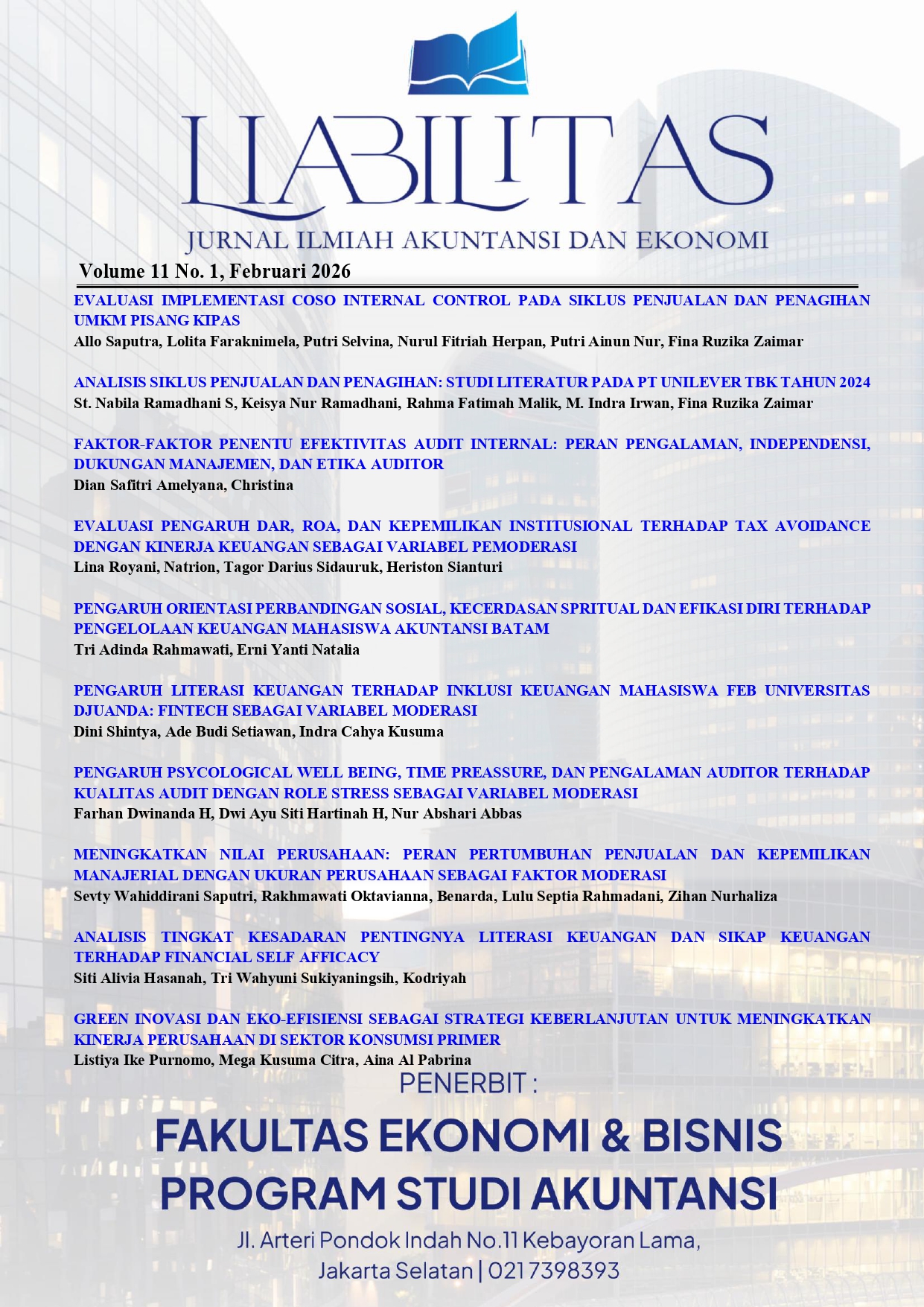
Analisis Tingkat Kesadaran Pentingnya Literasi Keuangan dan Sikap Keuangan Terhadap Financial Self Afficacy
DOI:
https://doi.org/10.54964/liabilitas.v11i1.627Keywords:
Financial Self Afficacy; Financial Literacy, Student; Financial Attitude.Abstract
This study aims to analyze the influence of Financial Literacy and Financial Attitude on Financial Self-Efficacy among Accounting students at Serang Raya University. The study uses a questionnaire survey method distributed to students of the 2023-2024 cohort. The results indicate that both Financial Literacy and Financial Attitude, either partially or simultaneously, have a positive and significant effect on Financial Self-Efficacy. In conclusion, an increased understanding of financial concepts and proper financial attitudes can enhance students' confidence in managing their personal finances.
References
Ajzen, I. (2019). TPB Questionnaire Construction Constructing a Theory of Planned Behaviour Questionnaire.
Atkinson, A. (2021). Measuring Financial Literacy: Results of the OECD/INFE Survey.
Chen, H. H. & G. M. S. (2021). The Impact of Financial Self-Efficacy on Financial Behavior: Evidence from College Students. Journal of Financial Counseling and Planning, 32(2), 221–226.
Wulandari, D. B. S. N. (2022). Financial Literacy Among Affirmative University Students. AL-ISHLAH. Jurnal Pendidikan, 14(3), 3995–4002.
Hafizd Fauzi, M. D. P. S. A. F. R. K. M. (2024). Analisis Tingkat Literasi Keuangan Dalam Pengelolaan Finansial Pribadi Mahasiswa. Akuntansi Pajak Dan Kebijakan Ekonomi Digital, 1(2), 37–50.
Huston, S. J. (2021). Measuring Financial Literacy. Journal of Consumer Affairs, 55(3), 641–659.
Kartini; Mashudi, U. (2022). LITERASI KEUANGAN (FINANCIAL LITERACY) MAHASISWA INDEKOS CALON PENDIDIK EKONOMI FKIP UNIVERSITAS JEMBER. Jurnal Program Studi Pendidikan Ekonomi, 10(2), 154–164.
Manalu, S. A. (2024). Analisis Pengaruh Literasi Keuangan, Digital Literasi, dan Financial Self-Efficacy terhadap Risky Credit Behaviour dalam Penggunaan Paylater pada Mahasiswa Fakultas Ekonomi dan Bisnis Universitas Sumatera Utara. Universitas Sumatera Utara.
OJK; BPS. (2025). Hasil Survei Nasional Literasi Dan Inklusi Keuangan (SNLIK).
Oktaviani, D. , & W. U. (2023). Pengaruh Literasi Keuangan dan Sikap Keuangan terhadap Perilaku Keuangan Mahasiswa di Yogyakarta. Jurnal Riset Keuangan Dan Akuntansi, 9(1), 42–53.
Otoritas Jasa Keuangan. (2016). Peraturan Otoritas Jasa Keuangan Nomor 76/POJK.07/2016 Tahun 2016 tentang Peningkatan Literasi dan Inklusi Keuangan di Sektor Jasa Keuangan bagi Konsumen dan/atau Masyarakat.
Ratna Sari, N. , & L. A. (2021). Pengaruh Literasi Keuangan, Pendidikan Keuangan di Keluarga, Uang Saku terhadap Perilaku Pengelolaan Keuangan dengan Financial Self-Efficacy sebagai Variabel Intervening. Jurnal Pendidikan Akuntansi, 9(1).
Sari, R. N. , & P. N. (2022). Determinant Factors of Students’ Financial Attitudes: A Case Study in Indonesia. Journal of Behavioral Economics and Finance, 3(2), 87–95.
Stolper, O. A. & W. A. (2023). Financial Literacy, Financial Self-Efficacy, and Investment Decisions: Empirical Evidence from Young Adults. Finance Research Letters, 51.
Sugiono, Prof. D. (2018). metode penelitian kuantitatif kualitatif.
widarjono. (2022). The Role of Financial Education and Social Influence in Improving Financial Self-Efficacy of University Students. Jurnal Keuangan Dan Perbankan, 26(4), 789–800.
Yusuf, M. , H. N. , & R. N. (2021). Analysis of Financial Attitudes and Their Impacts on Students’ Financial Management Behavior. Jurnal Ekonomi Dan Keuangan Islam, 7(2), 130–140.
Downloads
Published
How to Cite
Issue
Section
License
Copyright (c) 2026 Jurnal Liabilitas

This work is licensed under a Creative Commons Attribution-NonCommercial-ShareAlike 4.0 International License.